


Khe Sanh and A Shau Valley Operations
| General Westmoreland tasked the 1st
Cavalry Division with the combined mission of relieving the besieged US
Marines at Khe Sanh and thereafter conducting a reconnaissance in force in
the A Shau Valley. These large-scale operations were known as Operation
Pegasus and Operation Delaware.
Khe Sanh - Operation Pegasus The relief of the 26th Marine Regiment at Khe Sanh commenced on 1 April. On 21 January, NVA forces had completely surrounded this US Marine Regiment at Khe Sanh with a superior force of three to one. The enemy not only had a significant numerical advantage but they also commanded the initiative by preventing the Marines from conducting offensive operations outside of the base. Despite heavy bombardments by B-52s, tactical air and intensive counter artillery fires, the NVA was able to pound the runway and key installations at Khe Sanh with rockets, artillery and mortars throughout the 66-day siege. On 23 February, for example, the Marines reported receiving over 1,300 incoming rounds. The 1st Cavalry Division’s 3rd Brigade led the attack west by establishing two firebases almost halfway to Khe Sanh, while two battalions of the 1st Marine Regiment conducted a ground attack following Route 9 west toward Khe Sanh. Two days later, the 2nd Brigade landed three battalions southeast of the Khe Sanh base and attacked northwest toward the base. Enemy resistance was considered moderate until units of the 26th Marine Regiment who had been under siege at Khe Sanh for over two months, attacked and secured Hill 471 on 4 April. The following morning at first light, an enemy battalion charged up Hill 471 in a traditional infantry attack. According to the Marines on Hill 471, it was a very one-sided firefight as the attacking NVA forces were mowed-down by a combination of artillery fire, tactical air strikes and automatic fire from the Marine defenders. The mission of our brigade was to continue security of Quang Tri and to conduct operations south and west of the city. On 5 April, the 1st Bn 8th Cav was air assaulted into a LZ Snapper, located south of Khe Sanh and overlooking Route 9. Like the Marines on Hill 471, the 1st Bn 8th Cav was also subjected to an NVA attack on the following morning and once again, the enemy was forced to retreat after suffering high casualties. It is believed that our battalion established a blocking position close to the “Rock Pile”, where the forward battalion command post was subjected to a 122mm rocket attack. The relief of Khe Sanh was effected on 8 April, and the 1st Cavalry Division assumed responsibility for the Khe Sanh base and securing the area. In his concluding remarks on Operation Pegasus, the Commanding General of the 1st Cavalry Division, General Tolson, stated: “In fifteen days, the division had entered the area of operations, defeated the enemy, relieved Khe Sanh, and been extracted from the assault-only to assault again four days later into the heart of the North Vietnamese Army's bastion in the A Shau Valley”. |
|||||||||||||||||||||||||||||||||||||||||||||||||||||||||||||||||||
| A Shau Valley - Operation Delaware | |||||||||||||||||||||||||||||||||||||||||||||||||||||||||||||||||||
|
It is important to note that the NVA
“initiated” the Battle of Dak To (Nov 67), the Battle of Tam Quan (Dec 67),
the siege of Khe Sanh (Jan-Apr 68), and the Tet Offensive (Jan-Apr 68). Now
it was our turn to go on the offensive and on 19 April 1968, we “initiated”
a large-scale attack on NVA forces in one of their most important jungle
sanctuaries, the notorious A Shau Valley. The NVA overran the US Special Forces Camp in A Shau in March 1966, and according to General Tolson, Commanding General of the 1st Cavalry Division: ”The enemy had always considered the A Shau Valley to be his personal real estate and it was a symbol of his relative invulnerability.” For the NVA, the valley became a crucial part of the Ho Chi Minh Trail and served as one of their main points of entry for the infiltration of troops and supplies into the I Corps Tactical Zone. The A Shau Valley is less than ten kilometers from Laos, a country that the NVA exploited as a safe haven for moving troops and supplies into South Vietnam. Because of international law restrictions, US and allied forces were not allowed to engage NVA forces operating in Laos. Consequently, when the NVA bombarded us in the A Shau Valley with rockets and artillery fired from locations in Laos, we were unable to take any form of counteraction to silence their guns. |
HO CHI MINH TRAIL MAP |
||||||||||||||||||||||||||||||||||||||||||||||||||||||||||||||||||
 |
|||||||||||||||||||||||||||||||||||||||||||||||||||||||||||||||||||
| Thanks to Sven Gerlith | |||||||||||||||||||||||||||||||||||||||||||||||||||||||||||||||||||
|
The A Shau Valley was notorious because it left a lifelong mark on most of
us and we have great difficulty explaining why. The most likely explanation
was our exposure to many awesome and startling experiences during this
violent three-week operation, such as: The shattering explosions from the
C-130 Hercules aircraft loaded with ammunition that was shot down close to
our position with the loss of all the crewmembers. Being repeatedly shelled
by NVA artillery guns from locations in Laos and knowing that our folks were
not allowed to return the fire. Constant contacts with enemy forces
involving many firefights, ambushes and sniping activity. The large number
of our helicopters hit by enemy antiaircraft fire. The disturbing sound of
enemy tanks moving at night on the valley floor. While the triple canopy
jungle prevented the optimal use of our airmobile capabilities at Dak To,
the operational requirement to conserve helicopter fuel created a similar
situation during the A Shau Valley operation. To evade enemy antiaircraft
fire, our helicopters had to make a high altitude climb over the mountains
and then a sharp spiral descent into the A Shau Valley. Conducting combat
operations on such a vital stretch of the notorious and dangerous Ho Chi
Minh Trail. Tensely watching the sequence after the shooting down of a US
Air Force F-105 jet fighter with the ejection of the pilot and his slow
descent by parachute to safety. The large quantities of enemy material
captured, ranging from sophisticated military equipment to a stock of
bikinis. The noise and shock waves generated by B-52 strikes close to our
position. Then there was the unknown factor as succinctly stated by Captain
John Taylor (Cavalry Magazine, 1968): "The feeling the majority of the men
had upon first coming into the valley was a sort of fear; distinctly
different from that felt during Hue or Khe Sanh. We had heard so many
stories about A Shau... the possibilities of running into large
concentrations. We had a fear of the unknown. We thought that just around
any corner we would run into a battalion of North Vietnamese." Even the
“Dictionary of the Vietnam War” made an attempt to capture some of our
extraordinary experiences with this description: “The A Shau Valley was the
scene of much fighting throughout the war, and it acquired a fearsome
reputation for soldiers on both sides. Being a veteran of A Shau Valley
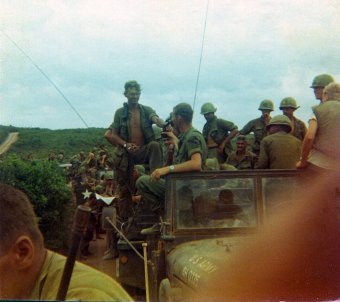
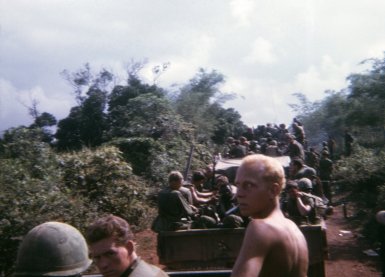
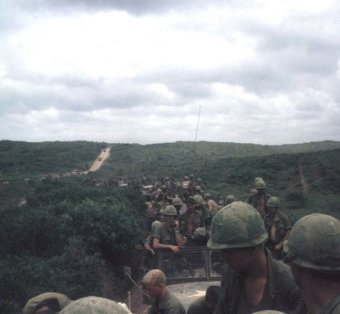
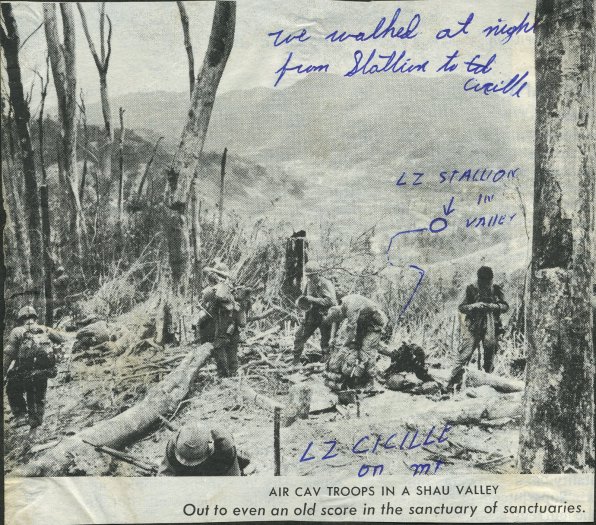
operations became a mark of distinction among combat veterans.” For Bravo Company, the A Shau Valley operation began with a truck convoy from Quang Tri to the large staging area in the vicinity of Camp Evans, the 1st Cavalry Division base camp at Hue-Phu Bai. The following photos show Bravo Company on the way to this staging area. |
|||||||||||||||||||||||||||||||||||||||||||||||||||||||||||||||||||
|
|||||||||||||||||||||||||||||||||||||||||||||||||||||||||||||||||||

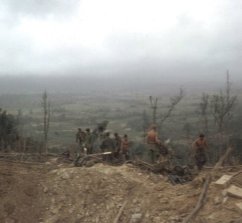
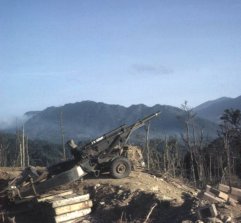
|
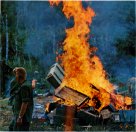
DESTROYING CAPTURED NVA EQUIPMENT |
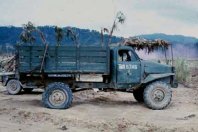
CAPTURED NVA VEHICLES |
CAPTURED NVA 37MM ANTI-AIRCRAFT GUN |
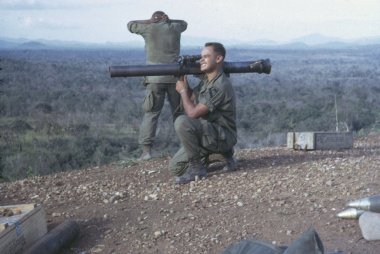
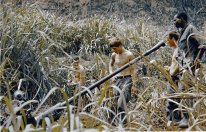
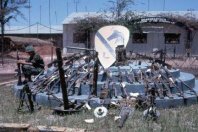
SOME OF THE NVA WEAPONS CAPTURED IN A SHAU |
|
|
|
|
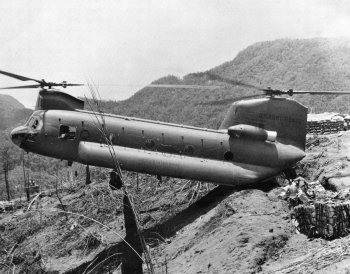
| CHINOOK OFFLOADING AT A SHAU VALLEY LZ | Thirty years after this photo was taken, we discovered that the pilot of this Chinook was Pat Murphy, C/228th Assault Helicopter Battalion, and here is his account from the Battalion website: This was “my ship, Crimson Tide 472, with its butt sitting on the edge of the LZ being unloaded as the front end is hovered. If I had known that this photo was being taken, I would have come out of the bird and posed for this guy.” |
 |
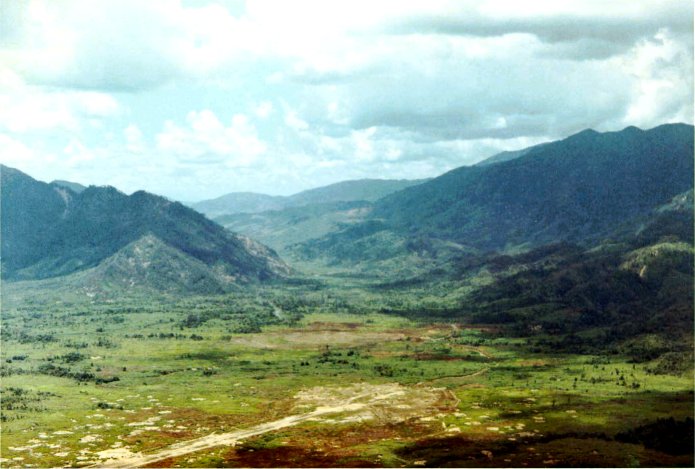
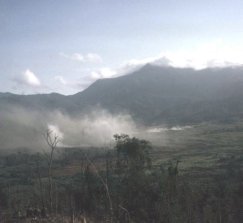
TACTICAL AIR SUPPORT CLOSE TO LZ CECILE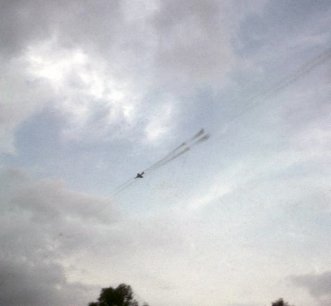 Thanks to Jim Smith |
AIR STRIKE A SHAU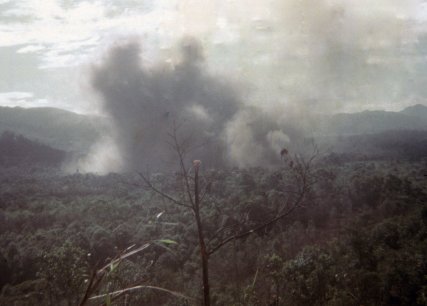 Thanks to Ralph Mercado |
There are several reports of enemy snipers operating close to our night defence positions and how the NVA shadowed our patrols. One of these snipers sneaked up on the Bravo Company Command Post on 6 May and shot Charles Haynes, our company radio operator. As a consequence of reduced visibility in the dense jungle terrain on the mountains and the tall elephant grass on the valley floor, we had numerous meeting engagements that completely surprised both sides and often resulted in hasty firefights. Here is what one of our troopers remembers about the NVA tanks that suddenly started moving along the valley floor close to LZ Cecile. “The night they fired the tanks up we were all standing around waiting to be interviewed by some famous newsman. He was at the next position to ours and I was rehearsing what I was going to say. Those tanks cranked up and when I turned back around the famous news guy was hauling a-- for the chopper. There must have been 50-60 guys shoulder to shoulder standing at the edge of that saddle between the two hills. I believe there were five of them. Whoever the FO was he was very good!” The tanks stopped when our artillery illuminated the area and cranked up again when dark. We could hear their voices as they shouted orders and directions. The following day, Blackfoot was sent down to follow the tank tracks that led towards Laos. The NVA had reinforced the road with planking and cleverly camouflaged the road by tying young treetops together to form an arch.
NVA TANK DESTROYED BY OUR ARTILLERY
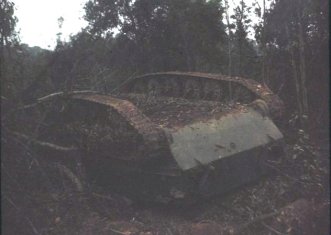 Thanks to Jim Smith |
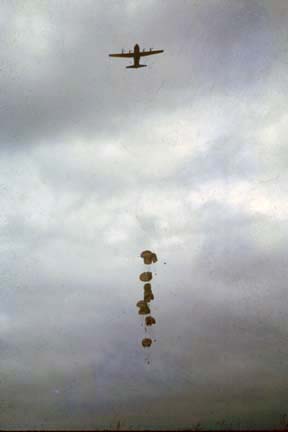
AIR DROP A
SHAU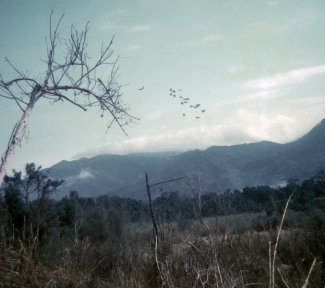 Thanks to Ralph Mercado |
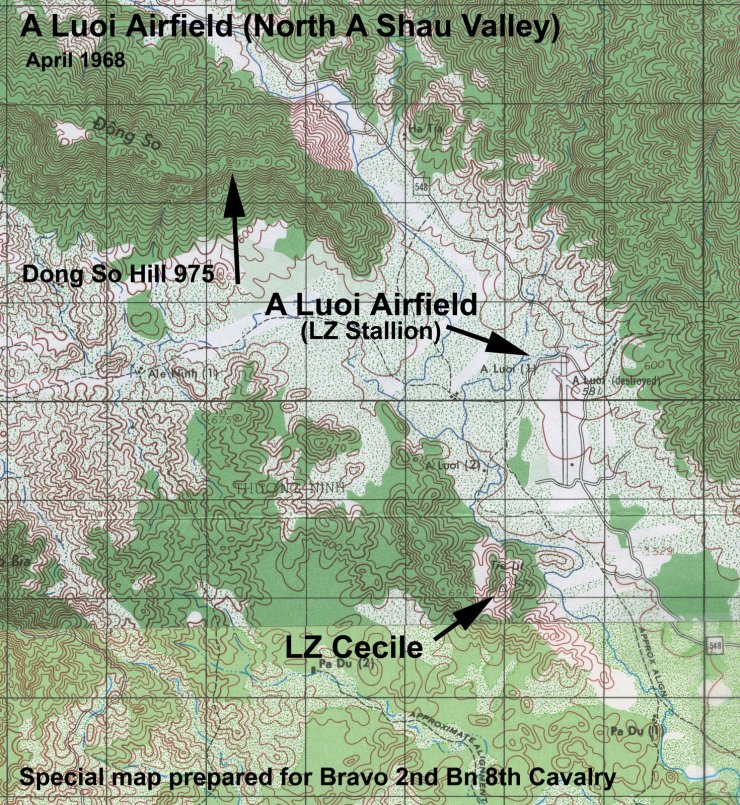
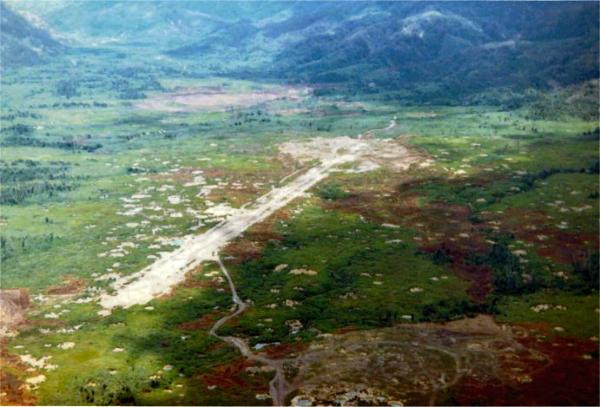
Those who witnessed the crash of the C-130 Hercules in the A Shau Valley will never forget it. It was 1400 hours on 26 April, and we all knew that the C-130 making its approach to air drop ammunition at A Luoi airstrip/ LZ Stallion had been hit by enemy antiaircraft fire and we sadly watched the gallant attempts by the pilot to maneuver the stricken aircraft toward a suitable site for a crash landing, but the C-130 hit some trees and the subsequent fire ignited the artillery munitions loaded on pallets inside the plane for the air drop. Later that night we heard and felt the US Air Force retaliating with B-52 strikes that caused secondary explosions to the south of our position. For a detailed account and photographs on the shooting down of this C-130, see the links at (description) http://www.spectrumwd.com/c130/articles/aluoi.htm and (series of photographs of the crash) http://www.vhfcn.org/alouix.html
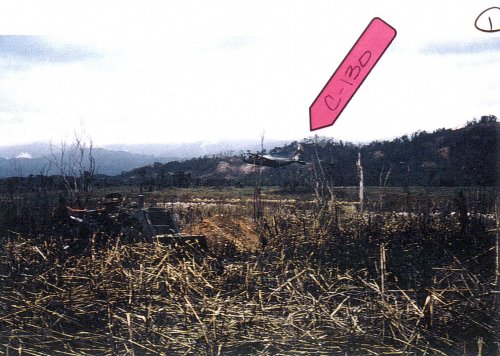 Damaged C-130 flying a low level S.E. to N.W. along the Valley Axis Just south of the southern end of LZ Stallion airstrip. The rear ramp is down. |
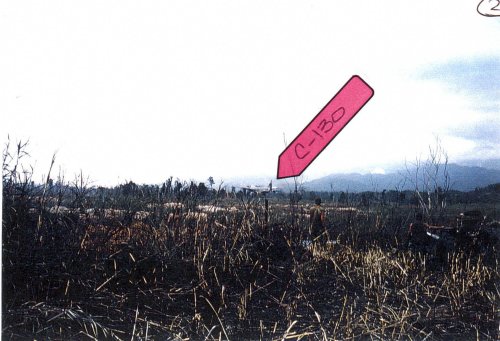 Note the battle damage to the fuselage, position of the control surfaces, fuel streaming from the left wing, and the abandoned NVA Bulldozer in the foreground. |
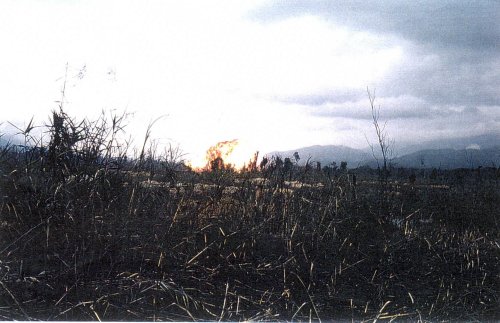 Impact
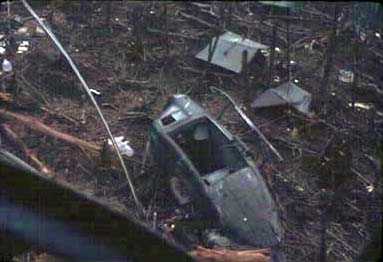
Shortly after the shooting down of the C-130, a Chinook was shot down at LZ Cecile and one of our Mohawk troopers provided this report on this incidence: “Our position on the perimeter was down the hill and the helicopter pad was up hill from us. A Chinook had dropped off its’ load and was starting to lift off when a NVA 50 Caliber machine gun opened up on it. The rounds were coming up the hill right over our heads. It dropped back to the ground from a very short distance. My guess would be the drop was around 20 feet. It all happened very quickly. I was paying more attention to the tracer rounds that were passing close over our heads. The downed Chinook was lightened then lifted out with a flying crane helicopter several days later.”
CHINOOK SHOT DOWN ON LZ CECILE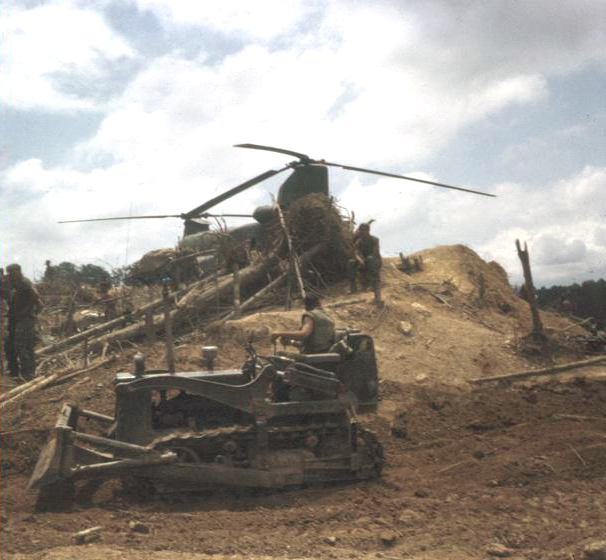 |
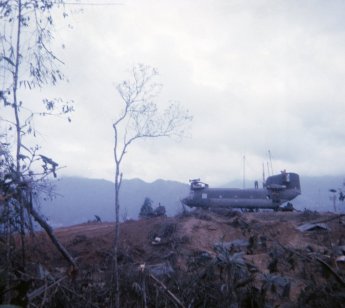 Thanks to Ralph Mercado |
There is a story attached to the above photo. There was a network news team who were in the process of making a comprehensive report on Bravo Company, but when they observed the shooting down of this Chinook on LZ Cecile, they quickly lost interest in us and hightailed it out of the A Shau Valley as fast as they could. As an example of rapid battlefield promotions during a single day, one of our troopers started off in the morning as pointman, then he became the fire team leader, and by the end of the day he was the squad leader.
During the A Shau Valley operation, the 1st Cavalry Division was confronted with the heaviest enemy air defense ever encountered in airmobile operations and the weather often aided the enemy. On many occasions, extremely poor visibility compelled our pilots to use flight paths underneath the clouds and NVA antiaircraft gunners exploited this by concentrating their fire on helicopters using these flight paths.
Extraction from the A Shau began on 10 May with elements of the 3d Brigade, while the remaining 1st Cavalry Division units continued offensive operations in the Valley until the end of Operation Delaware on 17 May. The A Shau Valley had not only served as a sanctuary, but also as an extremely important supply depot for NVA forces. According to General Tolson, “one of the greatest intangible results of this operation was the psychological blow to the enemy in discovering that there was no place in Vietnam where he could really establish a secure sanctuary. The enemy had always considered the A Shau Valley to be his personal real estate and it was a symbol of his relative invulnerability. Operation DELAWARE destroyed that symbol.”